About This Event
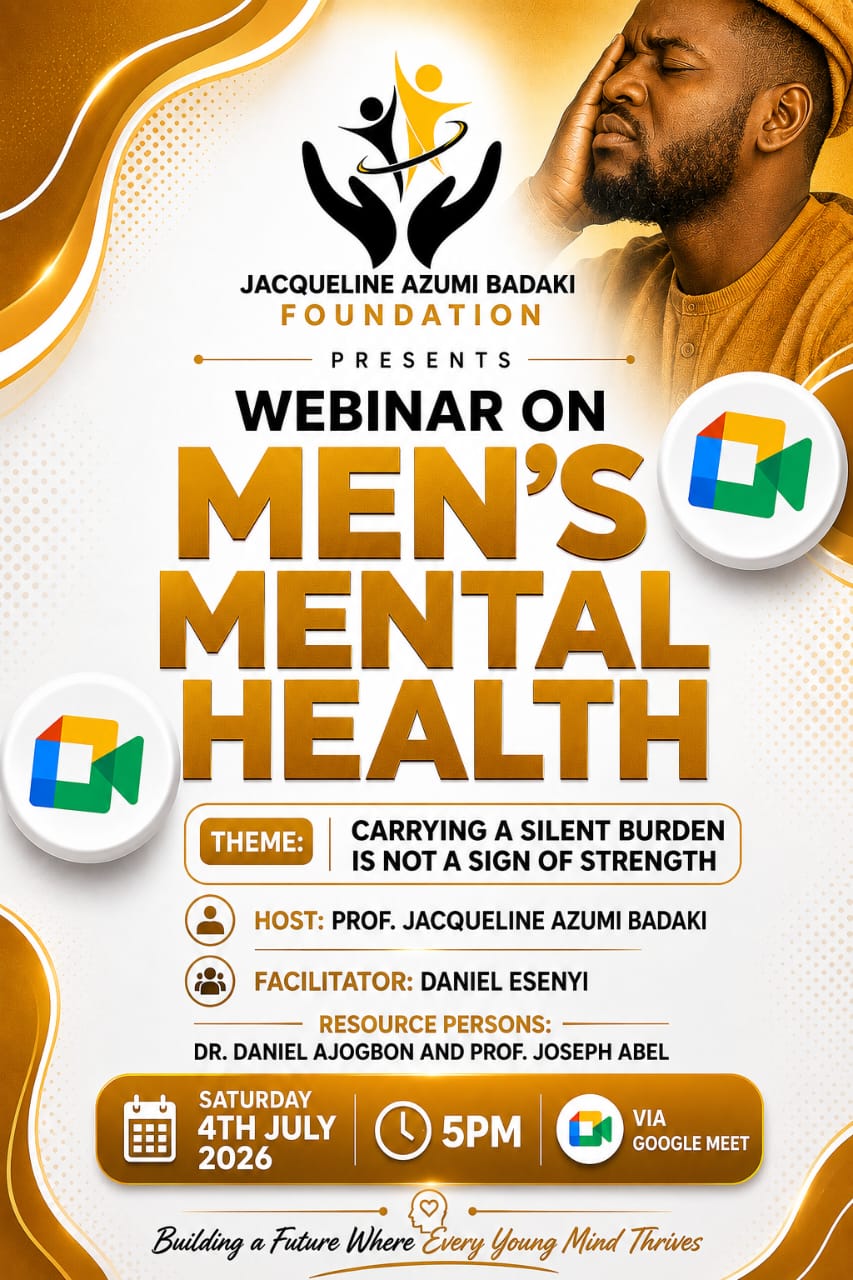
The JAB Foundation recently hosted a dedicated Men's Mental Health webinar to confront one of the most pervasive yet overlooked challenges in our society: men suffering in silence. The event, held on the 4th of July 2026, brought together academic leaders, clinicians, and community advocates to examine the emotional pressures men endure and offer practical pathways toward healing.
Opening the session, Daniel Esenyi welcomed the gathering and acknowledged the guests and then introduced Professor Jacqueline Badaki, the founder and executive director of the JAB Foundation. Daniel reflected on her extensive academic background, her leadership across public health initiatives, and her dedication to connecting scientific research with grassroots community action across Nigeria and the wider continent.
Taking the floor, Professor Badaki articulated the core mission of the JAB Foundation, emphasizing its sustained commitment to uplifting vulnerable groups impacted by poverty, conflict, and banditry. While the foundation champions reproductive health, youth empowerment, and personal wellbeing through initiatives such as community empowerment schemes, school outreaches and organizing monthly music therapy sessions.
This webinar addressed a distinct cultural crisis. Too many men carry their burdens alone because society discourages them from seeking help. The primary goal of the gathering was to ignite genuine, open discussions, encourage men to reach out when they are overwhelmed, and empower every participant to become an ambassador for emotional wellness within their local communities.
The Silent Burden
The conversation deepened with an address by Professor Abel Joseph, an authority in African postcolonial literary studies at Federal University Lokoja with a notable record of administrative service as Dean of Students and Director of Advancement and Linkages. Professor Joseph focused on what he termed the silent burden, painting a vivid picture of a heavily weighed down backpack packed with unresolved trauma, job insecurity, and bottled emotions that countless men carry daily. Though speaking from an observational standpoint rather than clinical psychiatry, he observed how men are conditioned by culture to man up, compelled by the rigid expectation to always act as an unshakable provider.
He explained that this silence is driven by modern pressures like the comparison trap on social media, the dread of failure, constant financial anxieties, and childhood messaging that wrongly equates silence with strength. In reality, keeping quiet builds a wall against essential emotional release. Over time, this unresolved tension manifests in severe physical and psychological damage, from alcoholism and sudden bouts of anger to insomnia, chronic hypertension, and even stroke. Most critically, he pointed out that male suicide rates are three times higher than those for women, with seventy percent of Nigerian men never speaking about what they endure. This behaviour becomes an unfortunate inheritance passed down to younger generations who mimic what they see. Urging attendees to break this pattern, Professor Joseph underscored that silence protects no one.
The Medical Perspective
Turning to the medical perspective, Daniel introduced Dr. Daniel Jay Aub, a consultant psychiatrist at the Federal Teaching Hospital. Dr. Aub expanded on the multidimensional nature of mental health, explaining that it is shaped by an intricate interplay of genetics, family history, socio-economic realities, and cultural expectations, rather than biological wiring alone. He shared the example of a thirty-one-year-old navigating family dependence alongside sudden isolation to demonstrate how quickly life stress can erode mental stability.
He cautioned that when emotional distress is shoved aside, it regularly surfaces as conversion disorders, where deep psychological strain produces physical ailments such as persistent fatigue, bodily weakness, unexplained digestive issues, and body aches that regular painkillers cannot resolve. Denied a healthy outlet, men frequently drift toward maladaptive coping habits, including self-medication, substance abuse, and career instability marked by constant job switching.
Clinical Approaches and Safe Spaces
Building on these insights, Daniel Ajogbon addressed the heavy weight of traditional stigma, urging individuals to validate their own feelings instead of seeking outside approval. He noted that creating safe spaces requires active, nonjudgmental listening rather than confrontation. Because distress shows up in everyday behaviour, changes in posture, work quality, or general demeanour, peers should step in proactively with care before a crisis deepens. On a clinical level, the foundation provides confidential support avenues, utilizing evidence-based frameworks like Cognitive Behavioural Therapy to help people step out of denial, alongside lifestyle practices such as exercise and medication review to transform crisis into long-term resilience. He stressed that common setbacks like job loss or failed exams are normal life events rather than unique personal burdens, cautioning that continuous, unaddressed struggles ultimately lead to systemic physical decline.
Interactive Discussion
The interactive segment opened candid exchanges on real-world hurdles. Daniel Esenyi raised the dilemma of trust, asking how introverts or individuals without the financial resources for therapy can find safe confidants without fearing their private vulnerabilities will be shared. Professor Joseph acknowledged that discerning who can genuinely protect confidentiality remains a significant hurdle, as some people prioritize gossip over empathy.
Adding to this, Emmanuel Awulu asked how we can dismantle the generational myth that African men do not cry. Professor Joseph responded that our cultural outlook is actively shifting, with movements like Soro Soke and evolving African literature nurturing a fresh consciousness that celebrates speaking up. He advised the foundation to take these conversations beyond digital spaces and into the wider public sphere, where countless men suffer simply because they do not know support exists.
Reflecting on practical remedies, Daniel Esenyi pointed out how the foundation uses monthly music therapy gatherings as a creative, welcoming gateway to explore themes of anxiety and depression. Bringing the session to a close, Professor Badaki expressed sincere gratitude to all the speakers and participants, affirming that the JAB Foundation will build upon these deliberations and explore establishing dedicated community support groups to ensure men always have a safe space to breathe and heal.
Event Gallery